| |
Mary Appears to Saint Catherine
Laboure
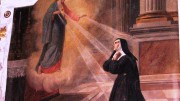
THE FIRST APPARITION On the eve of the Feast of Saint Vincent de Paul, July 19, the Sister Superior
spoke to the novices about the virtues of their Holy Founder and gave each of
them a piece of cloth from his surplice. Catherine earnestly prayed to Saint
Vincent that she might with her own eyes see the mother of God. She was convinced that she would see the Blessed Virgin Mary that very night;
and in her conviction, Catherine fell asleep. Before long, she was awakened by a
brilliant light and the voice of a child. "Sister Laboure, come to the Chapel;
the Blessed Virgin awaits you."
Catherine replied: "We shall be discovered."
The little child smiled, "Do not be uneasy; it is half past eleven, everyone is
sleeping... come, I am waiting for you." She rose quickly and dressed. The hall
lights were burning. The locked chapel door swung open at the angel's touch.
Amazed, Catherine found the Chapel ablaze with lights as if prepared for
midnight Mass. Quickly she knelt at the communion rail, and suddenly, she heard
the rustle of a silk dress... the Blessed Virgin, in a blaze of glory, sat in
the director's chair. The angel whispered: "The Blessed Mother wishes to speak
with you."
Catherine rose, knelt beside the Blessed Mother and rested her hands in the
Virgin's lap. Mary said:
"God wishes to charge you with a mission. You will be
contradicted, but do not fear; you will have the grace to do what is necessary.
Tell your spiritual director all that passes within you. Times are evil in
France and in the world."
A pain crossed the Virgin's face.
"Come to the foot of the altar. Graces will be shed on
all, great and little, especially upon those who seek for them. You will have
the protection of God and Saint Vincent. I always will have my eyes upon you.
There will be much persecution. The cross will be treated with contempt. It will
be hurled to the ground and blood will flow." Then after speaking for
some time, the Lady like a fading shadow was gone.
Led by the child, Catherine left the Chapel, marched up the corridor, and
returned to her place in the dormitory. The angel disappeared and as Catherine
went to bed she heard the clock strike two.
MARY REAPPEARS Catherine lived the normal life of a novice of the Daughters of Charity until
Advent. On Saturday, November 27, 1830, at 5:30 p.m., she retired to the Chapel
with the other Sisters for evening meditation. Catherine heard the faint swish
of silk... she recognized our Lady's signal. Raising her eyes to the main altar,
she saw her beautiful Lady standing on a large globe. The Virgin spoke, this time giving a direct order: "Have a
medal struck as I have shown you. All who wear it will receive great graces."
Catherine asked how she was to have the medal struck. Mary replied that she was
to go to her confessor, a Father Jean Marie Aladel saying of this saintly
priest: "He is my servant." Father Aladel at first
did not believe Catherine; however after two years, he finally went to the
archbishop who ordered two thousand medals struck on June 20, 1832. When
Catherine received her share of these first medals from the hands of the priest
she said: "Now it must be propagated."
The spread of a devotion to the medal urged by Saint Catherine was carried out
so swiftly that it was miraculous itself.
The Silent Life of Saint Catherine Laboure
THE SILENT SAINT We might expect that praise and prominence would be the lot of one so favored by
heaven. But she sought none of it; rather, she fled from it. She wanted to be
left alone to carry out her humble duties as a Daughter of Charity. For over
forty years, she spent her every effort in caring for the aged and infirm, not
revealing to those about her that she had been the recipient of our Lady's
medal. The Sisters with whom she lived held her in the highest esteem, and each
one longed to be her companion.
In 1876, Catherine felt a spiritual conviction that she would die before the end
of the year. Mary Immaculate gave Catherine leave to speak, to break the silence
of forty-six years. To her Sister Superior, Catherine revealed the fact that she
was the sister to whom the Blessed Mother appeared. On the last day of December,
1876, Saint Catherine passed on - once again to the hands of Mary - this time,
however, in heaven. Today her beautiful remains still lie fresh and serene.
When her body was exhumed in 1933 it was found as fresh as the day it was
buried. Though she had lived seventy years and was in the grave for fifty-seven
years, her eyes remained very blue and beautiful; and in death her arms and legs
were as supple as if she were asleep. Her incorrupt body is encased in glass
beneath the side altar at 140 Rue du Bac, Paris, beneath one of the spots where
our Lady appeared to her.
In the Chapel of the Apparition you can gaze upon the face and the lips that for
forty-six years kept a secret which has since shaken the world.
|
|
|
Our
Lady's Messages
Messages/Prophecies July 19: "Sorrows will befall France..." with "victims
among the clergy of Paris" (including the Archbishop) in forty years. Forty years later on July 19, 1870 the Franco-Prussian War began which resulted
in the siege of Paris with horror, famine and and the Paris Commune which killed
the Archbishop and many other clergy.
November 27: "These (gems on fingers with rays of light)
are the symbols of the graces I shed upon those who ask for them. The gems from
which rays do not fall are the graces for which souls forget to ask."

The Meaning of the
Front Side of the Miraculous Medal
Mary is standing upon a globe, crushing the head of a serpent beneath
her foot. She stands upon the globe, as the Queen of Heaven and Earth.
Her feet crush the serpent to proclaim Satan and all his followers are
helpless before her (Gn 3:15). The year of 1830 on the Miraculous Medal
is the year the Blessed Mother gave the design of the Miraculous Medal
to Saint Catherine Labouré. The reference to Mary conceived without sin
supports the dogma of the Immaculate Conception of Mary—not to be
confused with the virgin birth of Jesus, and referring to Mary's
sinlessness, “full of grace” and “blessed among women” (Luke 1:28)—that
was proclaimed 24 years later in 1854. |
The Meaning of the
Back Side of the Miraculous Medal
The twelve stars can refer to the Apostles, who represent the entire
Church as it surrounds Mary. They also recall the vision of Saint John,
writer of the Book of Revelation (12:1), in which “a great sign appeared
in heaven, a woman clothed with the sun, and the moon under her feet,
and on her head a crown of 12 stars.” The cross can symbolize Christ and
our redemption, with the bar under the cross a sign of the earth. The
“M” stands for Mary, and the interleaving of her initial and the cross
shows Mary’s close involvement with Jesus and our world. In this we see
Mary’s part in our salvation and her role as mother of the Church. The
two hearts represent the love of Jesus and Mary for us. (See also Lk
2:35). |
From 1832-36 is it estimated that over 10 million
medals were minted in France in an attempt to meet the demand of the people for
them: Catherine's director Fr. Aladel writes a book detailing the numerous
healings, conversions and other miracles. There have been countless miracles
associated with what was originally called the Medal of the Immaculate
Conception, which accounts for the popular name for it today ('Miraculous').
Here are a few noted examples: ~ 1832: Napoleon-appointed, unrepentant 'archbishop' of Paris suddenly repents
when the Medal was brought in his home Napoleon's unrepentant 'archbishop' of
Belgium suddenly repents when the Medal was brought in his home ~ 1841: Jewish banker Alphonse Ratisbonne accepts a dare to wear the medal and
say the Memorare, later seeing a vision of Mary, converting to the faith and
becoming a missionary to his fellow Jews ~ 1933: St. Catherine's body was exhumed for in the cause of her sainthood and
found to be incorrupt, as it remains so today as a witness to the authenticity
of her 'mission' ~ 1944: American prisoner Claude Newman picks up a discarded Medal, has a vision
of Mary and is converted at the time of his execution ~ 1947: the Grand Master of the Polish Masonic Lodges, Stempowski, is given a
medal to carry by St. Maximillian Kolbe. Newspapers reported his deathbed
conversion to the faith with credit given to the Medal
|